
Good Relations
We acknowledge that the land we gather on, Mohkinsstsis, is the ancestral territory of the Siksikaitsitapi — the Blackfoot people — comprising the Siksika, Kainai and Piikani Nations, as well as Treaty 7 signatories, the Tsuut’ina Nation and the Îyârhe Nakoda Bearspaw, Chiniki and Goodstoney First Nations. Today this land is home to the Otipemisiwak Métis Government Districts 5 and 6 as well as many First Nations and Inuit from across Turtle Island.
We acknowledge that there has been art, music, dance, storytelling and ceremony on this land since time immemorial and it is in the spirit of this land and its people that we do our work.
“Participation is based on the key human rights principles of individual autonomy and self-determination as part of basic human dignity. Human dignity differs conceptually from ideas often traditionally used in development, such as ‘satisfaction’ or ‘welfare,’ in stressing active choice as opposed to making people ‘passive recipients of benefit.’”
(FAO, United Nations, 2016)
Context
Calgary Arts Development (CADA) is committed to building and maintaining good relations internally and externally. Central to this commitment is our Reconciliation Journey and the values of Equity, Diversity, Inclusion and Accessibility (EDIA) that drive our work.
In the last decade, CADA has taken steps toward reconciliation, racial equity, sexual and gender diversity, and disability justice. Our journey toward a more equitable work environment, investment programs and public events has been gradual but ongoing.
We acknowledge that we are further along in some equity work, namely Indigenous reconciliation and racial equity, than others. Our work on intersectionality, disability justice and gender and sexual diversity are not as far along. We recognize the importance of developing our knowledge, understanding, and capacities in these areas.
We believe that Indigenous reconciliation stands apart from our other EDIA commitments and that everything starts with reconciliation. If we do not understand our relationship to this place we will not be able to advance our other EDIA goals.
In that spirit, in 2022, we adopted a Treaty 7 world view when creating our new four-year Strategic Framework. Its title Ákáakomatapoap is a Blackfoot word meaning we are now going to begin. It recognizes the transformational times the arts face.
In 2023, we started developing this Good Relations framework, which also adopts a Treaty 7 Indigenous world view, as a guide to how we engage with one another and with community. This is a living document; a starting point that will be continuously updated and revised as needed.
Purposes
- To provide a guide or roadmap for staff to understand the CADA way of engaging meaningfully with individuals, groups, and communities.
- To foster reconciliation and build trust and good relations with communities.
- To ensure community members have a chance to be involved in decision-making processes at CADA when appropriate through inclusion and participation.
Desired Outcomes
- Informed Decision-Making: This document is meant to provide insights, diverse perspectives, and relevant information to staff members. The aim is to help us make informed decisions that consider the interests and needs of all communities involved. This document is not a step-by-step guide, although it does provide a suggested process to follow for Indigenous engagement that can be applied to all different communities. Its main purpose is to provide a philosophy and some essential questions that can help guide you in your engagement with the community and among staff.
- Embedded and authentic engagement with the community: By actively involving the community, CADA can tap into its expertise, knowledge, and creativity. This can result in the generation of innovative ideas, improved project design and better policy outcomes. Engaged communities can offer valuable input, practical solutions, and contribute to the success of initiatives.
- Truth and Reconciliation with Indigenous Peoples: The idea of centering truth and reconciliation in this engagement framework is to confront the truth of Canadian history and foster improved relationships between Indigenous Peoples and non-Indigenous communities through our work.
Building Good Relations
Good relations through the lens of a Treaty 7 Indigenous world view
“The Blackfoot-speaking tribes begin their explanation of what the treaty means by explaining the concept of iinitsi or peacemaking. It is a concept that is also understood by the Nakoda Stoneys and Tsuut’ina as a broad process of peacemaking or of forging new relationships”
(From The True Spirit and Original Intent of Treaty 7).
Calgary Arts Development seeks to honour the true spirit of this land as understood by those who have lived on and cared for it since time immemorial – the Blackfoot, Tsuut’ina, Stoney Nakoda and Métis peoples. This vision sees art and culture as integral to how we relate to one another in a good way, in concert with the land and stewarding it for future generations. CADA’s Strategic Framework Ákáakomatapoap supports an arts ecosystem approach, which includes a deep connection to this land.
This perspective reflects Indigenous ways of knowing and aims to humanize organizational systems and processes by creating a culture that centres on fostering positive and respectful relationships both within and outside the organization. Building good relations is intended to encompass every relationship the organization is involved in, including those with artists, the community, Indigenous and Treaty 7 First Nations, the land, the City of Calgary, other arts organizations, the CADA board, and internal interactions. Furthermore, this approach should be applied to all contracts, agreements, communication, events, funding, terms of reference, operational tools, strategic planning strategies, and so on. Our goal is to ensure that all our actions and decisions are rooted in fostering good relations.
All staff share responsibility for establishing and maintaining mutually respectful relationships starting with those within our organization.
Good relations are constantly renewed. There are many ways of doing this depending on the community. It is important that renewal is done intentionally, and that it is flexible. For Indigenous communities this can often look like taking part in ceremonies, rituals and smudging. Other communities may have their own protocols. The actions we take will be guided by genuine relationship building and ongoing renewal.
Building good relations is, by nature, an anti-racist practice. By getting to know each other and listening to each other’s stories, we can come to value each person’s intrinsic value regardless of differences, power dynamics or the exchange of goods and services.
Good relations are built on mutual trust through an open-minded, open-hearted approach that allows learning, creativity and innovation. Beyond relationships between people, our aim is to integrate meaningful engagement into organizational systems and processes. This is not a project with an end date; it is an ongoing process.

The Tipi is a symbol of how CADA aims to engage internally and with the community. The four main poles of the tipi represent our four main principles of good relations.
- The Spirit of Reconciliation
- Artists’ self-determination
- Trauma Aware
- EDIA
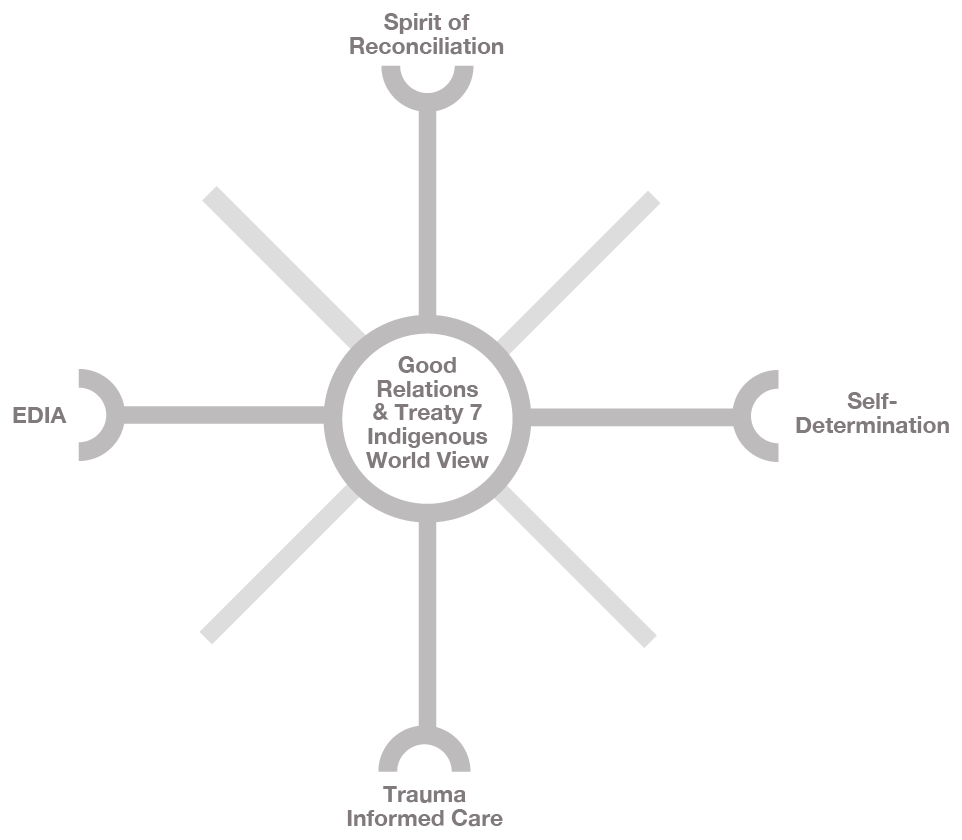
The Spirit of Reconciliation
“For the Canadian treaty makers, Treaty 7 was something that was more narrowly a legal agreement, later interpreted to have been a land surrender. The written text of the treaty did not encompass the spirit and intent of the whole treaty-making process. For the elders of Treaty 7, the treaty was an agreement that was to benefit both sides in a substantial way. Each side had to bring something substantial to offer to the other. The elders say that the Treaty 7 people’s offer to share the land with the newcomers has been of greater benefit to the government side than it was to the First Nations. The promises have not been properly fulfilled.”
– From The True Spirit and Original Intent of Treaty 7
CADA recognizes the Treaty 7 first nations’ sovereignty. When making big decisions, we consult our Indigenous Advisory, comprising Treaty 7 members, to help guide our decision-making process. We are in their traditional territories, and we are committed to being considerate and respectful of their sovereignty. The spirit and intent of the treaty, as understood by the Treaty 7 nations, was that people would come here and take on the nations’ values, respect for the land, and languages, and integrate into the way the nations do things. We respect that we are operating on the lands of other peoples and will shape our actions accordingly.
Reconciliation is a complex and ongoing process to address historical injustices, promote healing and understanding, and work towards a more equitable and respectful relationship between Indigenous and non-Indigenous peoples. According to the Truth and Reconciliation Calls to Actions:
- Reconciliation is a process of healing relationships that requires public truth sharing, apology, and commemoration that acknowledge and redress past harms.
- Reconciliation requires constructive action on addressing the ongoing legacies of colonialism that have had destructive impacts on Aboriginal peoples’ education, cultures and languages, health, child welfare, administration of justice, and economic opportunities and prosperity.
- Reconciliation must create a more equitable and inclusive society by closing the gaps in social, health and economic outcomes that exist between Aboriginal and non-Aboriginal Canadians.
- All Canadians, as Treaty peoples, share responsibility for establishing and maintaining mutually respectful relationships.
Many actions can be embedded in our work. The points below show examples of our work through a reconciliation lens, and we encourage all staff to think of ways to advance reconciliation in the work they do. We must understand that reconciliation is not a one-and-done proposition, but an ongoing process that requires long-term commitment and sustained efforts from all of us. The outcomes are not always immediate or easy to measure, but worth the effort as we work toward achieving a truly equitable, inclusive and accessible city where everyone belongs.
Improved relationships
Reconciliation efforts can foster improved relationships between Indigenous and non-Indigenous peoples. This can involve building trust, promoting dialogue, and engaging in meaningful consultations on matters that affect Indigenous Peoples.
With Indigenous leadership embedded in our organization and Indigenous individuals leading granting and public art programs, we have a good starting point on our reconciliation journey. We have ongoing relationships with Blackfoot Elder Saa’kokoto, an Indigenous Advisory and other Elders we have worked with. It is important, not only when we have questions or when we need advice, to remember that good relations must be constantly renewed. The CADA way is to start an Indigenous project through dialogue with Elders and Knowledge Keepers we are in relationship with before going down a path.
Recognition of Rights
Reconciliation often involves recognizing and affirming the rights of Indigenous Peoples, such as land rights, self-governance, cultural rights, and treaty rights. This recognition can lead to greater autonomy and self-determination for Indigenous communities.
We are in constant learning about rights and protocols and how to honour and respect them. Learning through online courses, books, digital resources, and dialogue is a starting point and the responsibility of all staff. Cultural practices and protocols are different for each nation. Learning about them and how to respect them can be assisted by our Indigenous staff, Advisory, and other Elders, Knowledge Keepers and Nation leaders we are in relationship with.
Redress for past injustices
Reconciliation can involve acknowledging and addressing historical injustices, such as the impacts of colonization, forced assimilation policies, and residential schools. This may include apologies, reparations, and other forms of redress to promote healing and justice.
CADA has grant investment programs specifically designed by and for Indigenous artists to ensure access to resources, address historical injustices and support authentic artistic expression and self-determination. Examples include OPIP, Honouring the Children, Microgrants and Public Art projects
Economic development and empowerment
Reconciliation can create opportunities for economic development and empowerment within Indigenous communities. This can involve initiatives such as supporting Indigenous entrepreneurship, promoting resource revenue sharing, and ensuring equitable access to education and employment opportunities.
Our main initiative in this realm is centering Indigenous Economic Development as one of the focus areas of our Cultural Activation Fund. Some examples include supporting the Authentically Indigenous Art Market, the North America Indigenous Games, and the Downey Wenjack Music Festival.
Cultural revitalization and preservation
Reconciliation efforts often focus on supporting the revitalization and preservation of Indigenous cultures, languages, and traditions. This can involve initiatives like cultural exchanges, language revitalization programs, and promoting Indigenous knowledge and practices.
Although all CADA grant investment programs are open to Indigenous artists, the OPIP program specifically supports the revitalization and preservation of Indigenous cultures, languages and traditions. The Aisinna’kiiks series promotes Indigenous knowledge and practices.
Policy and legislative changes
Reconciliation can lead to policy and legislative changes that recognize and protect Indigenous rights, promote equality, and address systemic issues. This may involve reforms in areas such as education, child welfare, justice, and healthcare.
This is outside the scope of our work, but we can and do think about how to make systemic changes in an effort to decolonize our own programs and policies.
Social and systemic change Reconciliation aims to address the underlying systemic issues that perpetuate inequality and discrimination against Indigenous Peoples. This can involve challenging stereotypes, combating racism, and promoting inclusivity and diversity within society
We find that other civic partners such as Tourism Calgary and Calgary Economic Development have consulted with us on how to approach reconciliation. Aisinna’kiiks is a specific CADA program that challenges stereotypes, combats racism and promotes inclusivity.
Self-Determination
“Indigenous peoples have the right to self-determination. By virtue of that right, they freely determine their political status and freely pursue their economic, social and cultural development”
– Article 3 of the UN Declaration on the Rights of Indigenous peoples
Free, Prior, and Informed, Consent (FPIC) is a tool that has been developed by the United Nations to ensure that Indigenous peoples have self-determination throughout engagement processes, project development, and program delivery.
It is important to mention that “FPIC is not only important for Indigenous Peoples but it is also good practice to undertake with local communities, as involving them in the decision making of any proposed development activity increases their sense of ownership and engagement and, moreover, helps guarantee their right to development as a basic human rights principles.”
We use FPIC as an inspiration for our engagement with all communities. In this section, we define what FPIC means and offer some reflections on how we can apply it to our work. The examples below are a starting point for thinking about our work through a FPIC lens.
Free, Prior, and Informed Consent (FPIC) – Key Elements
Free, Prior and Informed Consent is a specific right granted to Indigenous Peoples recognized in the UN Declaration on the Rights of Indigenous Peoples, which aligns with their universal right to self-determination. According to FAO at the United Nations, Free, Prior, and Informed Consent (FPIC) allows Indigenous Peoples to provide or withhold/ withdraw consent, at any point, regarding projects impacting their territories. FPIC allows Indigenous Peoples to engage in negotiations to shape the design, implementation, monitoring, and evaluation of projects.
Free
The consent is free, given voluntarily and without coercion, intimidation or manipulation. A process that is self-directed by the community from whom consent is being being sought, unencumbered by coercion, expectations or timelines that are externally imposed.
Free
Learn morePrior
The consent is sought sufficiently in advance of any authorization or commencement of activities.
Prior
Learn moreInformed
A collective decision made by the rights-holders and reached through customary decision-making processes of the communities.
Informed
Learn moreConsent
The engagement and type of information that should be provided prior to seeking consent and also as part of the ongoing consent process.
Consent
Learn moreAll elements within FPIC are interlinked, and they should not be treated separately. The first three elements (free, prior and informed) qualify and set the conditions of consent as a decision-making process. In short, consent would be sought before any project, plan or action takes place (prior), it should be independently decided upon (free) and based on accurate, timely and sufficient information provided in a culturally appropriate way (informed) for it to be considered a valid result or outcome of a collective decision-making process.
The definitions build on the elements of a common understanding of free, prior and informed consent endorsed by the United Nations Permanent Forum on Indigenous Issues (UNPFII) at its Fourth Session in 2005, and from the UN REDD Program Guidelines on Free, Prior and Informed Consent.
(2016) Free Prior and Informed Consent: An indigenous peoples’ right and a good practice for local communities – https://www.fao.org/3/i6190e/i6190e.pdf
Trauma-Aware
In 2023, the EDIA staff working group took the Trauma-Informed Care (TIC) e-Learning Series offered by Alberta Health Services to enhance their knowledge and develop trauma-focused skills in our work. The course fostered engaging discussions on the practical implementation of Trauma-Informed Care within the workplace, enabling the staff to explore strategies and best practices for creating a supportive and empathetic environment for everyone. Some of the information in this section has been taken directly from the Trauma-Informed Care (TIC) e-Learning Series website.
According to the Learning Series, there are six Guiding Principles of Trauma-Informed Care:
- Awareness
- Looking at trauma through the eyes of each individual
- Creating safety and trust
- Choice and collaboration
- Focusing on strengths
- Empowerment – recovery is possible
The Guiding Principles are the key items we need to know and understand to apply in our work. The principles are based on trauma research, practical knowledge of trauma intervention and lessons from trauma survivors. TIC is not a specific set of techniques or interventions. Its principles can be used across all sectors and service settings.
In this section we will explore each principle and provide some questions for reflection. These questions serve as a starting point for considering our work through a trauma-aware perspective rather than being a definitive list.
Principle 1 – Awareness
The starting point for all change is awareness. Awareness means understanding how common trauma is, and what a response to trauma may look like.
Awareness also refers to an understanding of self and others. Self-awareness is one’s ability to observe one’s thoughts, feelings, and behaviours and work toward understanding how they may impact both yourself and others.
Awareness of others ensures that we use our knowledge of trauma and emotion to understand the complex and varied presentations and coping styles of trauma survivors.
Apply it
What are some of the challenges faced by artists or arts organizations you are engaging with?
Are there culturally specific challenges or differences that might be relevant?
Does the person belong to a community with a history of cultural loss or trauma?
Are you being a good listener?
Principle 2 – Looking at trauma through the eyes of each individual
Emotions are very personal, and different people may have different responses to the same emotion.
Looking through the eyes of each person helps us better understand the individual and their responses, a concept often referred to as empathy.
Since everyone has a lifetime of experiences and memories, we can only understand another person’s situation when we listen without judgement.
This understanding helps build safety and connection in relationships.
Apply it
CADA already applies a similar principle to our work: “one size fits one.”
How can we recognize that awareness and knowledge are not the same as lived experience, while also offering support?
Are we gathering history and information about the current living situation of the individual that we are building a relationship with?
Can this information help provide access to the resources that this individual might need?
Principle 3 – Create safety and trust
Care, compassion and understanding are helpful when working with trauma survivors who often struggle to trust others and manage their emotions.
By acknowledging and validating their emotions, we not only assist trauma survivors in learning to trust themselves and others, but we also support the development of increased connection and feelings of safety. Individuals who feel safe are more likely to explore complex emotions and work toward resolving/managing them.
Apply it
How do you plan to create a safe and trusting space for individuals and communities?
Do you feel able and ready to have an emotional or heavy conversation? If not, what type of support or training do you need?
Are you self-aware about your emotional capacity for the day, or for that relationship?
Do you feel comfortable and ready to acknowledge and validate other people’s emotions?
If you feel overwhelmed by other people’s emotions or difficult conversations, how do you plan to manage the situation?
Principle 4 – Choice and collaboration
At the heart of emotional literacy is the idea of choice.
Having choice implies that we can learn to understand our emotions and choose how to manage them.
Trauma-informed care offers the guidance and resources to better understand and manage our emotions.
Since we all want to feel in control of our lives, helping a person understand that they can work towards controlling their biological responses to emotions and choosing how to respond can help them feel empowered.
Apply it
If you are facilitating a meeting, are you making it clear that everyone present has the autonomy and power to take a break, turn off their camera, step away, etc. at any time?
How can you approach every conversation respecting everyone’s right to self-determination?
Can you offer resources in a way that the person has options, and you are not telling them what they should choose?
What does self-determination mean to you and to the person you are engaging with?
When you offer choices are you prepared to adapt and for a potentially non-linear process?
Principle 5 – Focus on strengths
Everyone has strengths, and one of the greatest strengths is our ability to learn. For example, the skills of emotional literacy can be learned at any time during a person’s life.
Emotional literacy requires knowledge about the complexity of emotions, how emotions are generated, and how we can build emotional capacity.
Emotional literacy also requires learning the language and vocabulary of emotions, which in turn increases our ability to communicate our emotional experiences.
Knowledge is empowering and knowing how to ask for help is an important life skill.
Focusing on strengths helps a person feel engaged, which may increase their willingness to work on and improve their life situation.
Apply it
Are you aware of triggering language and how to adapt your language to be more neutral? For example, instead of saying “you are not allowed to…” you could say “here are some things to consider when thinking about this project.”
How can you support and encourage an individual by focusing on their strengths?
Principle 6 – Empowerment – recovery is possible
When we feel hopeful, we are more likely to see ourselves as good and competent people.
Although we may have shortcomings, a belief in ourselves helps motivate us to build upon our talents and skills.
This belief also enables us to take control of our lives and work toward change.
When using trauma-informed care, service providers work with trauma survivors to increase their sense of self-confidence and competence, an important component of the recovery process.
Apply it
What are the different ways you can support an individual to increase their sense of self-confidence and competence?
Are we approaching conversations with positivity and kindness?
Are we empowering individuals and communities to feel confident in making their own decisions?
Equity, Diversity, Inclusion and Accessibility
In 2018 when we started working with JD Derbyshire, they introduced us to three principles that have shaped our understanding of EDIA: Nothing about us without us; One size fits one; and Creating a virtuous cycle not a vicious one.
Nothing about us without us is a term insisting that those who are affected by a decision should be directly involved in the decision-making process. That the needs and lived experiences of members of the affected communities must be at the table from the beginning as programs, processes and policies are created.
One size fits one means we understand that one size doesn’t fit all. We understand that people have different lived experiences, needs and aspirations and we invite diverse points of view into the process from the beginning when designing programs, solving problems, organizing gatherings and communicating with people.
Creating a virtuous cycle not a vicious one starts with an understanding that everything is interconnected and ensuring that actions are always intentionally building toward positive outcomes and feedback loops not negative ones. When the values of EDIA drive our work, we are much more likely to create virtuous rather than vicious cycles.
Our current strategic framework (2023-2026) – Ákáakomatapoap – states that we are committed to equity, diversity, inclusion and accessibility (EDIA). Be sure to start with the principles of EDIA at the beginning of every program, project, process or action. These principles ensure that everyone has access to our programs and opportunities, whether it is an artist or arts organization seeking funding, a person seeking employment, or a community seeking support in some other way such as sponsorship or event support.
The following chart includes the definitions used by CADA as well as some questions for reflection on how to use these principles in our work. You may observe that some of the questions are like those related to trauma-informed care, demonstrating the interconnectedness and mutual reinforcement of the different principles.
You can find more information about CADA’s Commitment to Equity here: https://calgaryartsdevelopment.com/community-relations/commitment-to-equity/
Free, Prior, and Informed Consent
Free
Free means that information is offered transparently and objectively at the request of the rights-holders.
Free means that consent is given voluntarily and without coercion, intimidation or manipulation.
The process is self-directed by the community from whom consent is being sought, unencumbered by coercion, expectations or timelines that are externally imposed.
Information is offered transparently and objectively at the request of the rights-holders
The process is free from coercion, bias, conditions, bribery or rewards
Meetings and decisions take place at locations and times and in languages and formats determined by the rights-holders
All community members are free to participate regardless of gender, age or standing.
How this might relate to your work
Are you considering deeply and broadly about who is a rights-holder?
Are you ensuring rights-holders determine the process, timeline and decision-making structure.
Do meetings and decisions take place at locations and times and in languages and formats determined by the rights-holders?
Are you going to community or expecting community to come to you?
Are you coming in with preconceived notions? What are your own biases?
Are you parachuting into a community with information or more focused on long-term relationship building?
Are you being mindful of presenting choices and options when you set up meetings and information sessions?
Are you covering both the positive and negative potential of the proposed activities and consequences of giving or withholding consent?
Are you trying to push the community in a certain direction for the benefit of the project?
Are you being flexible enough?
If you are offering payment or reward, what is the payment truly for? Is it for a certain decision to be made, or is it to pay the people for their time knowledge and input?
Prior
Prior means that sufficient time is provided to understand, access, and analyze information on the proposed activity. The amount of time required will depend on the decision-making processes of the rights-holders and must be respected, as it reflects their needs and customs.
Information must be provided before activities can be initiated, at the beginning or initiation of an activity, process or phase of implementation, including conceptualization, design, proposal, information, execution, and following evaluation.
How this might relate to your work
What or who is determining the expectations and timeline for the project?
Is there a way to consult with our Indigenous leadership, Elder, Indigenous Advisory and other Elders and Knowledge Keepers we are in relationship with before a project begins?
Is there time built into the program design process for thorough community engagement with advisors, nations and stakeholders?
Are you building meaningful engagement with community into project timelines?
Have you considered the decision-making processes of the community we are working with and built this into our plan for the project?
Are you showing respect by being prepared for the engagement? We need to do our homework about the community before approaching the community, sharing information and getting their inputs. Are you aware of the protocols of the community we are engaging with?
Are you rushing the process or adding urgency due to external pressures and expectations, or not giving community the time and space to fully digest what is being proposed?
Are you operating on an “institutional” timeline without regards to how it affects artists and minority groups?
Can rushing through projects create stress on relationships?
If a project needs to be rushed, what pieces need to be prioritized to maintain good relations with the community?
What is a sufficient timeline for your project to be understood, verified, and happen with a focus on building and maintaining good relations?
Are you allowing for time and space for the community to change their mind? Have you created a safe space where people are able to change their minds at any time?
Have you made it clear that the community can consult with whomever they would like to before reaching a decision?
Are you considering accessibility when planning a meeting with community?
Informed
Informed refers mainly to the nature of the engagement and type of information that should be provided prior to seeking consent and as part of the ongoing consent process.
Information should be accessible, clear, consistent, accurate and transparent.
Information should be delivered in the local language in a culturally appropriate format (consider radio, traditional/local media, video, graphics, documentaries, photos, face-to-face meetings, oral presentations, or new media).
Information should be objective, covering the positive and negative potential of the proposed activities and consequences of giving or withholding consent.
Information should be complete, including a preliminary assessment of the possible economic, social, cultural and environmental impacts, including potential risks and benefits.
Information should include the nature, size, pace, duration, reversibility and scope of any proposed project, its purpose and the location of areas that will be affected.
Information should be delivered by culturally appropriate personnel, in culturally appropriate locations, and include capacity building of indigenous or local trainers.
Information should be delivered with sufficient time to be understood and verified.
Information should be provided in an ongoing and continuous basis throughout the FPIC process, with a view to enhancing local communication and decision-making processes.
How this might relate to your work
Have you researched how this specific community best receives news and information?
Do you understand what information the community wants and needs? What you might consider relevant or irrelevant may not be the same as what the community wants or needs.
Are you using clear and plain language in all communications?
Are you sharing initial information about the project in advance so the community can explore the initial ideas and in a way that is culturally appropriate and effective?
Are you actively encouraging a diversity of community members to participate and potentially apply?
Are you using language in calls that does not encourage potential applicants to self-exclude from opportunities?
Is the information complete, including the nature, size, pace, duration, reversibility and scope of any proposed project, its purpose and the location of areas that will be affected?
Are you considering accessibility when planning a meeting with community?
Before the project starts, are staff and community together exploring and assessing possible economic, social, cultural and environmental impacts, including potential risks and benefits?
Does the community have a voice in identifying potential impacts and benefits?
Have you given enough information for the community to be able to understand the project in depth?
Can you co-create with the community the nature, size, pace, duration, reversibility and scope of the project, its purpose and the location of areas that will be affected?
Can you reflect to the community what you heard and ask them if what you heard was correct?
Does the project have culturally appropriate staff leading it and do they have capacity for additional or short notice work for culturally sensitive conversations?
Are you documenting the proceedings and outcomes of the discussions and making them available to everyone involved?
Are you providing information regarding the communication and engagement channels for CADA / the project?
Are you making an effort to identify additional needs that should be included in the project during discussions with local communities?
Consent
Consent refers to the collective decision made by the rights-holders and reached through the customary decision-making processes of the affected Indigenous Peoples or communities.
Consent must be sought and granted or withheld according to the unique formal or informal political-administrative dynamic of each community.
Indigenous peoples and local communities must be able to participate through their own freely chosen representatives, while ensuring the participation of youth, women, the elderly and persons with disabilities as much as possible.
Consent is a freely given decision that may be a “Yes” a “No” or a “Yes with conditions” including the option to reconsider if the proposed activities change or if new information relevant to the proposed activities emerges.
Consent is a collective decision (e.g. through consensus or majority) determined by the affected peoples in accordance with their own customs and traditions.
Consent is the expression of rights (to self-determination, lands, resources and territories, culture).
Consent is given or withheld in phases, over specific periods of time for distinct stages or phases of the project activities. It is not a one-off process.
How this might relate to your work
Have you considered the decision-making processes of the community you are working with and built this into the project plan? Are you recognizing that the community might have different values, and therefore may value different rights than you might have expected?
Are you conscious of power dynamics that might be present as a representative of a large institution funded by the City of Calgary and as a funder?
Are you respecting their right to self-determination? Is it possible to consult the community regarding how they want to make their collective decision respecting their own customs and traditions?
Beyond political structures like chief and council, is the wider community of people including women, children, youth, hereditary chiefs, councils, and alternative structures they may have in place other than traditional western systems being consulted? Are community members free to participate regardless of gender, age or standing?
Are you interpreting the consent given through a western lens? Other cultures may give consent or revoke consent in ways that aren’t clear to those unfamiliar with the culture.
Are you making sure to clarify that the answer given is what you think it is? Some people may agree or disagree in different ways. Are you using strategies to clarify and confirm the given decision?
Do you have a plan B to accommodate changes in consent? Do you understand the reason consent was revoked or not given in the first place?
Is the right of the community to refuse being respected?
If consent is withheld, can you establish the causes and conditions that need to be met for the community to give their consent and is the community able to determine the times and conditions for renegotiation?
Is the collective decision been made by consensus or majority? And is this in alignment with the customs and traditions of the community you are working with?
Is the agreement reached mutual and recognized by all parties? How are you reaffirming consent?
Are you seeing the project plan in phases rather than one process? Are you checking in with consent at each phase?
Do you have a plan when a community is opposed to certain parts of a project? Can you clarify which parts are acceptable and which parts need to be adapted or abandoned?
How well is staff listening and incorporating the communities’ concerns and solutions into the agreement?Are you documenting the agreement process and outcomes?
Equity, Diversity, Inclusion and Accessibility
Equity
We believe in creating equitable access for Calgarians who have had less opportunity for philanthropic and governmental support due to systemic barriers that exist in our community.
Organizational reflections:
How can we model equity within the organization?
How can we ensure our policies do not inadvertently disadvantage any group?
How can we ensure our resources are distributed in a way that addresses the needs of the most underserved and vulnerable populations?
What mechanisms do we have in place to hold us accountable for our equity goals?
How often do we review and update our policies to ensure they are equitable and inclusive?
Responses may include training; hiring practices; awareness building, outreach and community engagement; grant assessment processes including selection of assessment panels and accommodations; specific granting programs like OPIP, ArtShare, and Honouring the Children.
Individual reflections:
How do I define equity in the context of my work and the communities I serve?
What are the specific needs and challenges faced by different groups within the community?
Can I accommodate some of these needs?
What implicit or unconscious biases might influence my interactions and decisions?
Diversity
We believe in supporting artistic endeavours that reflect our diverse community and in supporting the work of artists of diverse backgrounds.
Organizational reflections:
How is CADA modelling diversity?
What steps are we currently taking to ensure our staff, board, programs, projects and events reflect the diversity of Calgary?
Who are the different cultural, ethnic, racial, gender, sexual orientation, age and ability groups within our community?
How is CADA educating staff about the cultures, histories and experiences of the community members the organization serves?
How is CADA ensuring diverse representation in decision-making processes?
Is CADA respectful and knowledgeable about cultural difference in its interactions and services?
How is CADA engaging with diverse community groups to understand their needs, perspectives, and experiences?
What implicit or unconscious biases might staff hold that could affect our interactions with diverse community members?
How is CADA addressing and challenging discrimination within our organization?
Responses may include: thoughtful placement of board, job and artist calls; advice from the community working group, wisdom circle, Indigenous Advisory; intentional outreach to diverse communities; diverse assessment committees; the stories chosen for the Storytelling Project.
Individual reflection:
What are my own biases and how might they affect my interactions with diverse community members?
How am I actively working to recognize and challenge my own biases?
What steps am I taking to educate myself about different cultures and perspectives?
Am I creating an environmnent where everyone feels welcome, valued and respected?
How do I ensure my services are accessible to all community members, including those from marginalized or underrepresented groups?
What barriers might exist that prevent diverse groups from reaching out to me, and how can I address these barriers?
How am I engaging with diverse community members to understand their needs, perspectives, and experiences?
What strategies am I using to build trust and relationships with different community groups?
In what ways am I acting as an ally to marginalized or underrepresented groups within the community?
How do I ensure diverse voices are represented in my work and decision-making processes?
Am I creating opportunities for underrepresented groups to have a platform and be heard?
Inclusion
We believe in engaging a wide variety of voices and perspectives in shaping and furthering the work we do.
Organizational reflections:
How is CADA modelling inclusion within the organization?
How are we engaging with community members to understand their needs and perspectives?
How are we ensuring that all voices, especially those on the margins, are heard and valued in our decision-making processes?
What methods are we using to build trust and relationships with different community groups?
How is CADA soliciting and responding to feedback from the community, especially from marginalized groups?
Are our communication channels and materials inclusive and accessible to all community members?
What steps are we currently taking to ensure inclusion in our organization, programs and events?
Reponses may include: staff training, staff surveys, HR policies to support a sense of belonging within the organization; one-on-one conversations with community members; advice of the community working group, staff working group, and advisories.
Individual reflections:
Am I using language that is clear, respectful and inclusive?
Do I actively listen to the group or a member of the community, ensuring they feel heard and understaood?
Do I encourage open dialogue and create a safe space for community members to express themselves?
Do I encourage and facilitate participation in discussions and decisions?
Am I culturally sensitive and respectful of the individual’s values, traditions, and preferences?
Do I use interpreters or translation services when needed?
Am I patient and considerate in my interactions?
Accessibility
We believe in eliminating systemic barriers that prevent people who encounter physical, mental, or cultural barriers to spaces, programs, and services from participating in the arts.
Organizational reflections:
How are we modelling inclusion within the organization?
Are our services and programs accessible to everyone in the community, including those with disabilities and language barriers?
How well do we understand the diverse accessibility needs within our community?
Are we aware of different types of disabilities and the barriers people face?
How do we ensure our communications are understandable for people with cognitive disabilities or language barriers?
Are CADA staff trained in how to interact with and assist individuals with different types of abilities?
Do we understand our role in ensuring accessibility and know where to seek guidance or resources?
How do we solicit feedback from individuals with disabilities about their experiences accessing our services?
Responses might include: accommodations and accessibility policy, application assistance policy; ASL interpreters; ask people signing up for events to let us know what they need; accessibility measures during the hiring process; accessible washroom; CWG working pod.
Individual reflections:
How well do I understand the different types of disabilities including physical, sensory, cognitive and mental health disabilities?
What are the specific needs and callengs faced by individuals with disabilities in my community?
Are my services and facilities physically accessible to individuals with mobility impairments?
How do I ensure my communication methods and materials are accessible to individuals with visual, hearing or cognitive impairments?
What accommodation and modifications do I provide to support the participation of individuals with disabilities?
What training have I received on disability awareness and inclusion?
How do I stay informed about best practices for serving individuals with disabilities?
How am I engaging with individuals with disabilities and disability advocacy groups to understand their needs and perspectives?
What strategies am I using to build trust and ensure meaningful participation from individuals with disabilities?
In what ways am I using my position to influence positive change for individuals with disabilities?
How do I ensure that individuals with disabilities have a voice in decision-making processes?
Processes in the case of conflict between staff and community
Regrettably, conflict can occur in any working environment, especially when part of the work involves engaging with diverse communities. There are various reasons conflicts may arise, including cultural norms, communication gaps, differing expectations, power dynamics, economic disparities and lack of trust.
Conflict also has the potential to be a powerful resource when individuals can transform animosity into a spirit of collaboration and creativity. If individuals are open to better understanding the root causes of conflict, the process can change the relationships and structures that fuel it. Tackling the underlying issues and transforming conflicts into opportunities can lead to more sustainable and long-lasting resolutions. Moreover, it can promote changes in systems and structures that perpetuate conflict, leading to more fair and equitable social arrangements. Finally, transforming conflicts at an early stage helps prevent escalation and reduces the likelihood of future disputes1. So, in case you encounter a misunderstanding with a community member, below are some steps you can take and some other resources available.
Important: Please note that the processes suggested in this document focus on the staff’s engagement with the community, not internal conflicts. If you are dealing with an internal conflict, please refer to the Employee Policy Manual.
Steps to consider:
- Make an effort to speak to the person you are having the dispute with. Many times, disputes arise due to misunderstandings and miscommunications.
- If speaking to the individual does not work, speak to your direct supervisor to get some direction and guidance.
- The engagement team and the EDIA Staff Group are also available in case you would like to explore different options.
- If, after exploring internally, you are still not able to find a resolution, below are some other processes that are available to you:
Advisors
Elder Saa’kokoto, Cesar Cala, JD Derbyshire, and Cheryl Foggo are available for conversation with staff about some of the challenges you might face when engaging with the community. They are available to the staff to provide perspectives and advice. It’s important to note that they are not responsible for solving any conflict, nor are they available to work as mediators.
The Circle Process2
The circle process is designed to facilitate open dialogue, build relationships, and resolve conflicts within a community. Circles are powerful tools for transformative conflict as they create a conducive environment for dialogue, understanding, and collaborative problem-solving. By fostering trust, empathy, and mutual respect, circles help transform conflicts at their root, leading to more sustainable and peaceful resolutions.
On this platform, a neutral facilitator or circle keeper is chosen to guide the process and maintain a safe and respectful environment. The idea is to ensure respectful and constructive communication, foster active listening, identify issues, explore underlying causes and collectively evaluate potential solutions.
Approach and Philosophy:
- Collective Participation: The circle process emphasizes collective participation and inclusivity, with all members of the circle having an equal voice.
- Transformative Focus: The goal is not just to resolve the immediate conflict but to transform relationships, address underlying issues, and build community cohesion.
- Informal and Relational: The process is more informal and focuses on building relationships and mutual understanding.
- Facilitator’s Role: The facilitator (often called a circle keeper) plays a less directive role, mainly ensuring that the process flows smoothly and that everyone can speak.
- Process-Oriented: Emphasis is placed on the process of dialogue and mutual understanding rather than just the outcome.
Mediation3
Calgary Arts Development may pay for an external mediator to assist with the situation, with the approval of the President & CEO. You and the community member(s) are welcome to invite a bystander to join the conversation.
Approach and Philosophy:
- Third-Party Facilitator: Mediation involves a neutral third party (the mediator) who facilitates the process and helps the disputing parties reach a mutually acceptable agreement.
- Problem-Solving Focus: The primary goal is to resolve the specific dispute at hand by finding a practical solution that both parties can agree on.
- Confidential and Formal: Mediation sessions are usually confidential and follow a structured, formal process.
- Mediator’s Role: The mediator often takes a more active role in guiding the discussion towards possible solutions, and keeping the process on track.
- Outcome-Oriented: The focus is on achieving a concrete outcome, typically a written agreement that outlines how the conflict will be resolved.
1 You can find more information about transformative conflict and mediation here: Foster, K. (2003, June). A study in mediation styles: A comparative analysis of evaluative and transformative styles. Mediate.
2 You can find more information about Circle Processes here: Pranis, K. (2015). Little Book of Circle Processes : a New/Old Approach to Peacemaking. Skyhorse Publishing Company, Incorporated
3 There are many different resources around Mediation. You can find more information here: https://mediate.com/
Moving Forward and Nurturing Good Relations at CADA
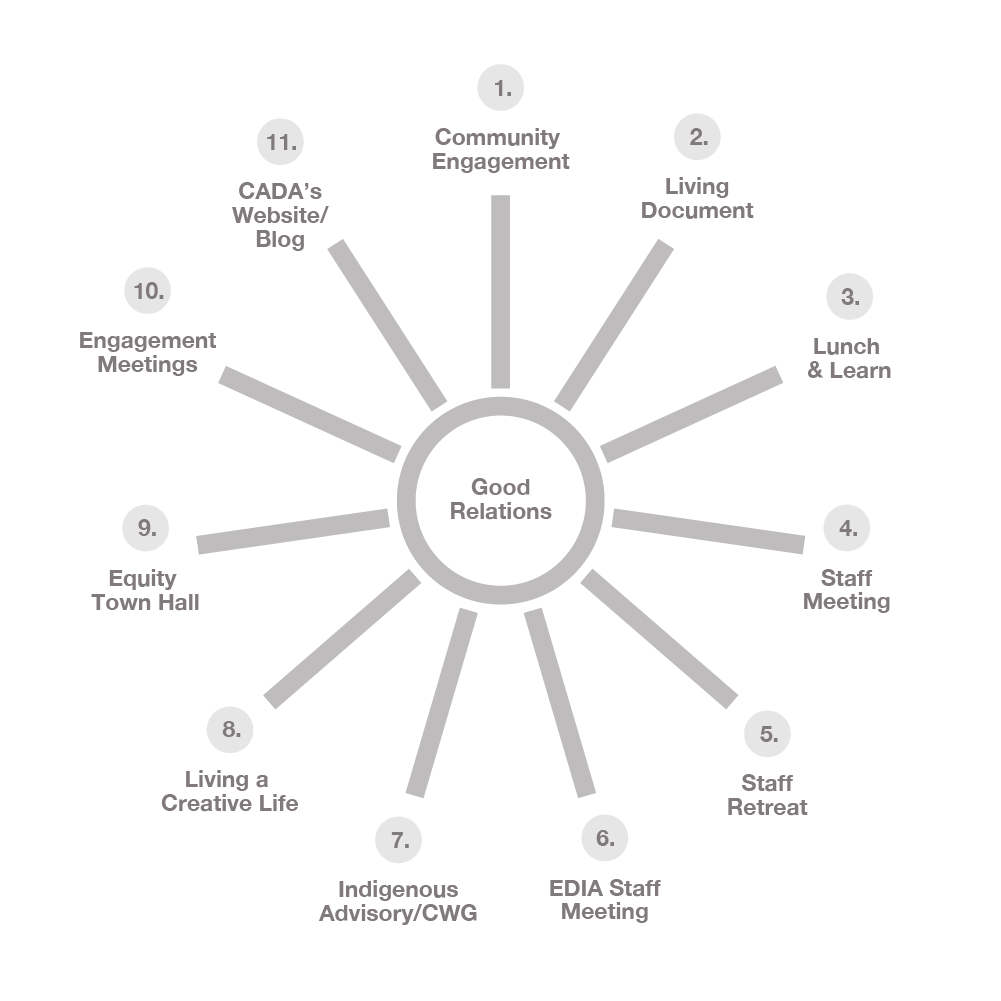
CADA offers various tools and spaces to facilitate the advancement of good relations internally and with the community. Good relations should underpin all of these efforts. We suggest the following:
- Community Engagement: Building good relations with a community involves active engagement, listening and genuine interactions. When beginning to engage with local communities, we suggest observing Appendix I – Best Practices for Indigenous Engagement and the four principles discussed in this document: The Spirit of Reconciliation, Artists’ self-determination, Trauma Awareness and EDIA. The community liaison and the director of Indigenous relations are available to all staff.
- Review and adjust this document annually as we see it as a living document.
- Use Lunch & Learn to share what CADA has been working on regarding building good relations internally and with the community.
- Reflect on how Staff Meetings can be an opportunity to build and nurture good relations internally. What are we doing in staff meetings to build good relations? * Departments updates
- Staff Retreats (team building) provide opportunities to connect to the land, share space together, and build good relations with each another.
- EDIA Staff Meetings provide a valuable platform for staff to engage in dialogue, fostering good relations and positive relationships within the organization. These meetings offer an ideal opportunity to discuss important issues such as EDIA, Truth & Reconciliation in the community and among staff members. Such discussions help to go beyond tokenism, therefore contributing to a more inclusive and supportive working environment.
- Indigenous Advisory is key to CADA building good relations with the different T7 communities and supporting the changes in our programs. As Indigenous communities are not monolithic, members of the advisory are diverse and have a trusting relationship with their own communities.
- The Community Working Group (CWG) for Equity, Diversity, Inclusion and Accessibility is part of a broader initiative to identify and remove systemic barriers in our work at CADA.
- The Living a Creative Life Storytelling Project is a tool that amplifyies the voices of local artists, especially those that are not heard as often through mainstream channels.
- The Equity Town Hall is a tool to support and nurture diverse art and artist-led city building to foster not only a resilient and sustainable arts ecosystem, but also to achieve a truly equitable, inclusive and accessible city where everyone belongs. The Equity Town Halls build and nurture good relations with the arts community.
- Department Check-In Meetings: Check-in meetings are valuable for building good relations within our teams.
- CADA’s Website/Blog: CADA’s website is a valuable tool to keep nurturing good relations with the community through community-centric content, interactive features, social media integration, community resources, feedback mechanisms, amplifying local initiatives and causes, accessibility and inclusivity.
Consistency is key to community engagement. Building strong and good relationships takes time and effort, so be patient and committed to sustaining meaningful connections with your community.
Appendices
Best Practices for Indigenous Engagement
Identify
Identify which nation(s) you would like to engage with.
Learn
Learn about Indigenous communities.
Plan
Create an engagement plan.
Engage
Make contact and engage.
Maintain
Maintain relationships through familiarity and openness.
Co-Design
“Co-design is a process of designing with, rather than designing for. Those who are most impacted by the design, especially those with needs least served by existing designs, are involved in the process from its earliest stages. They are engaged throughout the process and directly contribute to the creation of designs that meet their unique needs. Participants are not involved as research subjects or consultants, rather as designers engaged in active and sustained collaboration.” From: https://co-design.inclusivedesign.ca/design-process/
Not all CADA programs, processes and policies go through a co-design process, but those involving outcomes for the community may benefit from a process that is participatory and inclusive. The previous section on Free, Prior and Informed Consent will be helpful as you create space for members of affected communities to participate in a decision-making process.
Aspirations from the Imagine This Report
- Community members are trained to be able to facilitate community co-design sessions.
- In this possible future, acquired co-design skills help move through the messy middle between incremental and transformational changes. Community co-design skills are taught to all team members for use inside CADA and outside CADA.
- Speculative Design or Social Dreaming as a way of imagining the future comes before redesign of policy, assessment, procedures and program redesign. Moving from possible futures to plausible actions is a skill set of every CADA employee.
- Resources
- Community co-design kit. https://co-design.inclusivedesign.ca
- The principles of community co-design. https://commonedge.org/the-principles-of-community-codesign/
CADA Resources
The Indigenous Advisory was formed in 2017 and has 5 – 10 members, with representation from all Treaty 7 Nations, as well as Métis, Inuit, and Urban Indigenous people.
CADA’s Indigenous Advisory is a group that was originally formed to advise on the Original Peoples Investment Program (OPIP). The Indigenous Advisory provides advice, insights, and recommendations on matters related to Indigenous issues, rights, and interests. The Indigenous Advisory may consult in the following ways:
1. Provide Expertise: Members of the advisory often possess deep cultural, social, environmental, and historical knowledge of their communities. They offer insights that may not be readily apparent, to help us make decisions in a more comprehensive and respectful manner.
2. Cultural Sensitivity: The advisory ensures that our programs, initiatives and actions are conducted with cultural sensitivity, respecting Indigenous traditions, values, and practices.
3. Policy and Program Development: The advisory can provide input during the development and implementation of policies, programs, and projects that impact Indigenous communities to ensure our decisions align with the needs and beliefs of these communities.
4. Consultation and Consent: Many decisions affecting Indigenous communities require consultation and, in some cases, free, prior, and informed consent as outlined earlier in this document.
The EDIA Community Working Group (CWG) was formed in 2020 and is composed of arts community members and CADA staff and consultants. Community members are people who are practicing artists or arts workers (including organizational directors and or administration) who are deeply involved in social justice, change-making or equity organizing within their own communities.
The CWG is part of a broader initiative to identify and remove systemic barriers in our work at CADA. It is a paid collective of artists who help build collective capacity in the arts sector for EDIA and is centred on equity-seeking communities, specifically Indigenous, Black and People of Colour, Deaf, Mad or disabled and 2SLGBTQIAP+.
Members of CWG have been involved with Equity Town Halls, discussions around Art for Social Change and participating in reviewing and improving CADA’s policies. CWG is a space where staff can connect with BIPOC artists and learn about their experiences, challenges and perspectives. It’s an opportunity to build trust and nurture good relations with the arts community. In 2025 the CWG will focus on specific initiatives through working pods focused on ArtShare Program and Equitable Granting Practices, Demographic Data Collection, and Accessiblity and Inclusion Policies and Practices.
Calgary Arts Development recognizes that EDIA work has been ongoing in the community and the working group is an important step and opportunity to connect this work with our own institutional commitment to EDIA.
The Disability Justice Circle and Just Culture are groups of artists and arts workers living with disabilities who are available to advise us on matters that affect artists with disabilities.
The Wisdom Circle comprises a group of established artists and community members whose experience, knowledge and insights benefit CADA. The circle has included Blackfoot Elder Saa’kokoto, community activist Cesar Cala, disability justice and equity advocate JD Derbyshire, and renowned writer and filmmaker Cheryl Foggo. Members of the circle meet periodically with our president and CEO as well as other members of the staff to provide perspectives and advice.